

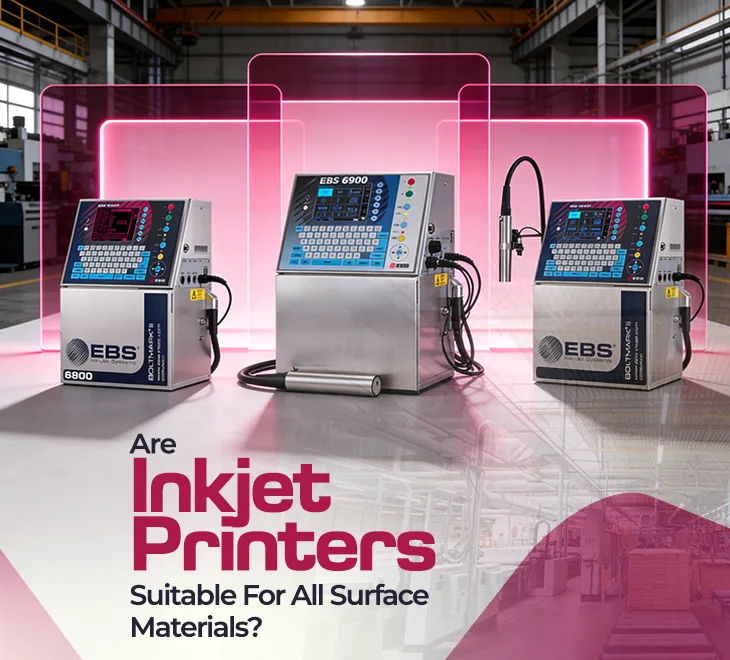
Inkjet printing is mostly used in commercial and industrial sectors, mainly for branding, marking, coding, and labelling. Most production lines use a variety of materials that are increasing in variety every day. This raises the question, “Do inkjet printers really work on all surface materials? An inkjet printer is known for its features of adaptability and effectiveness. The surface that is printed on can affect it. Factors such as printer configuration and ink formulation have to be understood to select the right solution.
In sectors of manufacturing and packaging, industrial inkjet printer Dubai solutions that provide printers that can print on different materials, even in demanding environments, are preferred. Even though the technology has grown a lot, surface compatibility isn't universal.
Understanding Inkjet Printer Technology
Inkjet printers work by pouring small drops of ink onto a substrate, creating codes, images, or texts. This process occurs at high speed in industrial applications, most of the time on uneven or moving surfaces. The quality of the print depends on how well the ink sticks to the surface and how fast it dries or cures.
Industrial inkjet printers are made in such a way that they can work non-stop in extreme environments with heat, humidity, dust, vibration, etc., unlike office printers. But these conditions can influence its effectiveness on different surface materials.
Deeper Dive Into Surface Material Compatibility
Inkjet Printing: Most Used Surface Materials
Industrial inkjet printers are used on various surface materials. Some of them are:
- Paper
- Cardboard
- Plastic: containers and films
- Glass: bottles and panels
- Metal surfaces: coated and uncoated
- Wood/engineered boards
- Rubber
- Synthetic materials
- Ceramic products
- Tiles
All of these materials react differently with ink. The adhesion levels, clarity of the print, and durability can vary.
Material Properties That Affect The Print Results
While inkjet printers are excellent printers and can be used across a variety of materials, they won't provide consistent performance on all surfaces. Main characteristics that can affect the print quality are:
- Porosity: The ink absorption levels of the material are a very important factor. Absorbent materials like paper allow the ink to penetrate quickly. This leads to quick drying, too. Non-porous materials like metal or plastic depend on the adhesivity of the ink to bond to the surface, as ink can't soak into them.
- Texture: If the surface is smooth, the ink must be fast-drying or curing to avoid smearing or smudging. Rough surfaces require ink that can be clear even across uneven areas.
- Surface energy: The energy of the materials has a deep impact on the printout. Certain plastics are made of low-energy materials. This will cause the ink to repel unless a different ink formula or treatment method is used.
As all these characteristics can impact the print results, surface testing must be conducted before starting the full process.
Formula Of The Ink And Its Surface Compatibility
The type of ink and its formula determine if the inkjet printer can be used on a specific surface.
- Water-based inks: They are apt for absorbent materials such as paper, but they won't stick to non-porous surfaces.
- Solvent-based inks: They provide very strong adhesion, especially on surfaces like glass, metals, and plastics. This is the reason why they are commonly used in industrial marking.
- Pigment-based inks: They are suitable for harsh environments, as they won't fade in the presence of moisture or chemicals.
- Inks curable with UV: This ink can harden instantly under UV light. It has longer durability even on surfaces that aren't absorbent. This makes it suitable for high-speed printing.
Ink that is suitable for the materials to be used must be chosen for good and long-lasting print results.
Surface Versatility Of Inkjet Printers
Inkjet printers are compatible with a wide range of materials, while standard printers aren't. They support different ink types, adjust to various ink parameters, and integrate with surface treatment systems. The flexibility of this printer allows the manufacturers to print on flat, curved, rigid, and flexible surfaces. Industrial inkjet printer Dubai manufacturers also create machines that match certain surfaces rather than creating a universal machine.
Printing And Surface Considerations
Industrial inkjet printers can be used on most surface types with the right technology and ink formula. While most printers require adjustments to match certain surfaces, inkjet printers are very flexible, making them a preferred printing method for most industries. Understanding the ink properties, surface characteristics, and curing methods is the first step in gaining the perfect print.
 Categories
 Our Brands