

There’s a moment every manufacturer knows too well: the production line is running perfectly, orders are ready to ship, deadlines are tight… and then someone notices it. The codes are smudged. The ink didn’t stick. The batch numbers are unreadable.
Suddenly, thousands of products risk rejection, compliance issues, or worse, which can lose the customer trust. In industries where every mark matters, printing is not just a task. It is accountability stamped onto a surface.
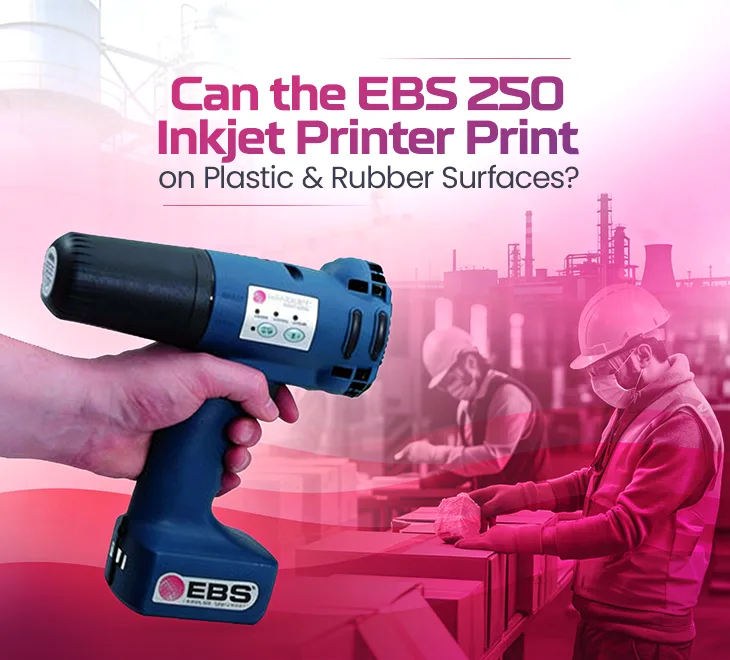
This is exactly where the EBS 250 inkjet printer enters the conversation, not as another machine, but as a solution designed for real industrial pain points. But the big question remain is ‘Can it actually print effectively on plastic and rubber surfaces?’ No, let’s just look into what makes this printer stand out.
The Real Challenge: Printing Beyond Paper
Plastic and rubber are two materials that are difficult to print onto since most printers were originally designed for printing onto cardboard or paper. When printing onto plastic or rubber, the ink will likely have trouble adhering to the surface due to its resistance properties, which can be due to the smoothness, flexibility, oiliness or unevenness of the surface. Consequently, many manufacturers experience issues with:
- The fading of printed codes during transit.
- The rubbing off of codes on flexible rubber parts.
- Poor appearance of printed codes on curved plastic packaging.
- Frequent reprinting of items due to delays in the production process.
Manufacturers looking for solutions to print reliably onto plastic materials, especially ebs 250 Dubai, tend to have experiences similar to those listed above. This means they require a printing solution that creates durable prints that will not fade.
EBS 250's Performance on Plastic Surfaces
Plastic packaging and the variety of manufacturing processes are increasingly becoming popular in today’s marketplace. With plastic being used for applications from bottles and containers to cables and automotive parts, the EBS 250 Dubai offers high-performance inks that permanently adhere to the non-porous surface of plastics.
What does this include?
- High-adhesion industrial ink that is designed to dry fast when printed onto a smooth surface of plastic.
- The ability to adjust the print settings based on different surface textures or finishes.
- Non-contact printing process, which does not create any pressure, so the printed item cannot be damaged by the printer
Whether you are printing expiry dates on bottles or serial numbers on moulded parts, users who have installed ebs 250 commonly report an excellent result from the printer, maintaining clear and readable print at approximately production speed.
The outcome of using the ebs 250 is that your printed code will be distinct and long-lasting and will hold up to the stress of being transported, stored and shipped.
Printing on Rubber: Where Precision Truly Matters
Rubber surfaces are even more challenging. They flex, absorb vibration, and often carry oils or residues from manufacturing. Yet the EBS 250 performs impressively because it’s engineered for industrial adaptability.
It achieves reliable rubber printing through:
- Fast-drying ink formulations that resist smearing.
- Strong contrast visibility on dark surfaces.
- Stable ink projection that adapts to uneven textures.
For industries producing tyres, seals, pipes, or industrial belts, businesses adopting ebs 250 Dubai solutions find that markings remain readable even after bending, stretching, or exposure to rough environments. That durability is not just convenient, it’s critical for traceability and compliance.
Mobility: The Hidden Advantage
One feature that surprises many users is portability. Unlike bulky coding systems fixed to one production line, the EBS 250 is handheld and mobile. Operators can move freely across workstations, print on large or irregular objects, and reduce downtime.
Imagine marking oversized rubber components without repositioning them, saving both labour and time. This flexibility is one reason demand for ebs 250 Dubai systems continues growing across logistics, construction, and manufacturing sectors.
Conclusion
Printing codes may seem insignificant initially, but there is so much more to consider than just those tiny marks; they're responsible for providing authenticity, verifying compliance with legislation, and providing an excellent image of your brand.
When the code on a product becomes faded or unreadable, you lose credibility as a company. On the other hand, when the code is clear and readable, your customers are able to build their trust in your company.
The EBS 250 not only print on plastic or rubber, but it also helps resolve the biggest issue that manufacturers deal with daily, which is certainty. Certainty that each product has a clear identity, regardless of the substrate.
In today's competitive environments, that certainty can be worth a great deal. Because sometimes, success isn’t about making more products, as it is all about making every product count.
 Categories
 Our Brands